


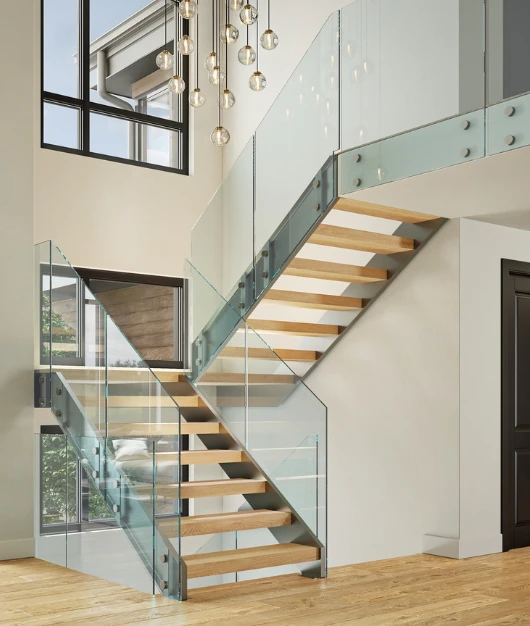

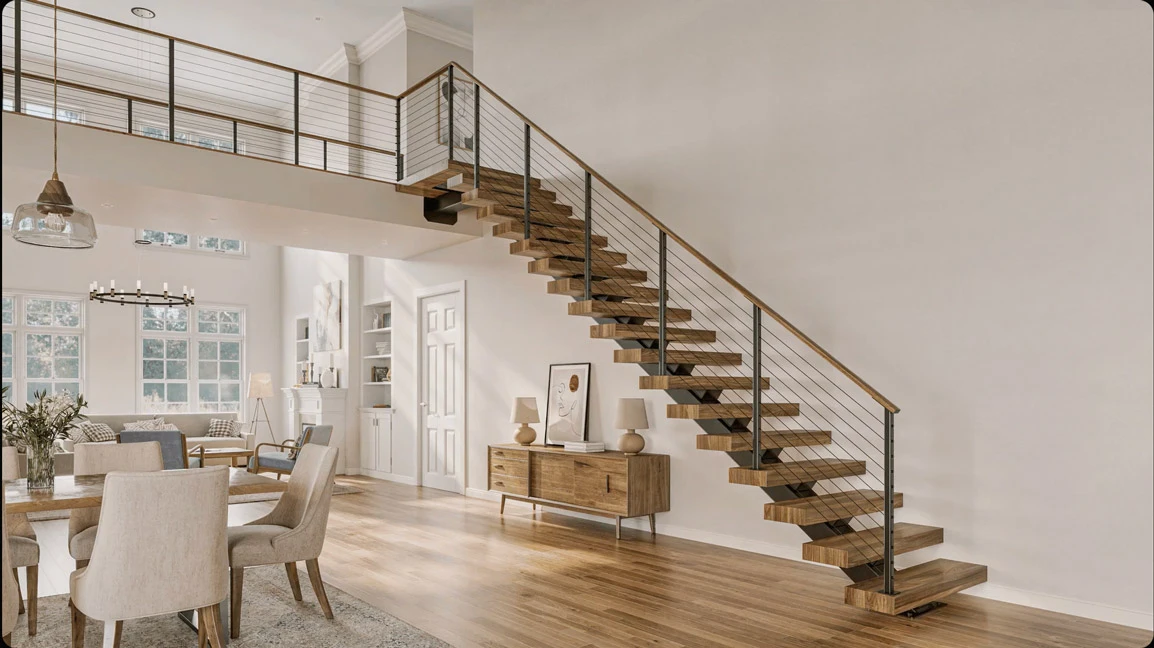

Floating stairs can be safe for kids and pets when the complete stair system is properly engineered, assembled, and designed for the household. Open-riser gaps, guard openings, handrails, tread grip, and lighting all matter. Toddlers and small pets may need additional protection beyond the minimum building code requirements.
What families should check first
Start with a stair and railing design that meets local requirements. Then plan for your child’s age, climbing behavior, your pet’s size, and everyday footing. A hardware-mounted gate at the top of the stairs, suitable railing infill, secure tread surfaces, and clear lighting can make a meaningful difference.
Floating Stair Safety at a Glance
| Household question | Practical answer | Design priority |
|---|---|---|
| Are floating stairs safe for kids? | They can be, with a compliant design and age-appropriate precautions. | Check open risers, guards, graspable handrails, and gate mounting points. |
| Can dogs use floating stairs? | Many can; comfort varies with size, mobility, and confidence. | Evaluate grip, tread visibility, and openings a small animal could fit through. |
| Is cable railing suitable? | A properly specified system can satisfy code. Household climbing behavior still matters. | Confirm opening limits, cable deflection, tension, and maintenance. |
| Is a closed-riser stair safer? | It removes the gaps between treads, but still needs suitable guards and handrails. | Compare the complete design and the needs of its users. |
What Makes a Floating Staircase Safe?
Floating stairs create an open appearance by minimizing the visual bulk of the structure. An open riser is the gap between adjacent treads where a solid vertical riser would otherwise sit.
A stringer is the sloping structural member supporting the treads. Paragon’s mono stringer stairs use a central support beam, while dual stringer stairs use two beams. Wall-cantilevered treads are another floating-stair approach, rather than a synonym for all floating stairs.
A guard is the barrier protecting an open edge. A handrail provides a graspable surface for support while using the stair. One assembly can serve both functions if it meets both sets of requirements.
Structural integrity and load capacity
The light appearance does not eliminate the need for engineered treads, stringers, anchors, and connections. Under 2021 IRC Table R301.5, stairs have a minimum uniform live-load requirement of 40 pounds per square foot. Individual treads must resist that uniform load or a 300-pound concentrated load over a 2-by-2-inch area, whichever produces greater stresses. These are alternative tread load cases, not two loads simply added together.
The same table lists 200-pound concentrated loads for guards and handrails, with application details in the table notes. These are design criteria, not a per-person weight limit or a reason to test a railing yourself.
Paragon has in-house design and engineering teams. Ask which drawings, connection details, and engineering documentation apply to your selected configuration and support conditions. A generic code value does not establish the capacity of every existing stair or attachment.
Floating Stair Safety: What the Residential Code Requires
These selected 2021 International Residential Code (IRC) provisions apply to conventional residential stair flights, including straight floating designs. They are a reference for planning; the edition and amendments adopted locally control your project. Spiral stairs and commercial projects have different provisions.
| Safety detail | Selected 2021 IRC requirement | Section |
|---|---|---|
| Open-riser gaps | Openings located more than 30 inches vertically above the floor or grade below must prevent passage of a 4-inch-diameter sphere. | R311.7.5.1 |
| Where guards are required | Open-sided walking surfaces more than 30 inches above the floor or grade below, measured at any point within 36 inches horizontally of the open edge. | R312.1.1 |
| Guard height | Generally at least 36 inches. At open sides of stairs, at least 34 inches above the line connecting tread nosings. If the guard top also serves as the handrail, it must be 34 to 38 inches high. | R312.1.2 |
| Guard openings | Generally must prevent a 4-inch sphere from passing. Stair-side guards have a 4⅜-inch sphere exception. The triangle formed by the tread, riser, and guard bottom rail must prevent a 6-inch sphere from passing. | R312.1.3 |
| Handrails | Required on at least one side of a flight with four or more risers. Generally 34 to 38 inches above the sloped line connecting tread nosings. | R311.7.8 and R311.7.8.1 |
| Tread depth and riser height | Rectangular treads at least 10 inches deep; risers no higher than 7¾ inches. Uniformity and other geometry requirements also apply. | R311.7.5.1 and R311.7.5.2 |
The open-riser rule concerns the opening’s height above the floor or grade below, rather than the stair’s total rise. The 4-inch, 4⅜-inch, and 6-inch limits apply to different openings and should not be used interchangeably.
References: SMA guidance on risers, treads, guard locations, guard openings, handrails, and handrail height; 2021 IRC Chapter 3.
Floating Stairs Safety for Kids
Plan stair gates before choosing the railing
For the top of the stairs, use a hardware-mounted child safety gate designed for that location. The U.S. Consumer Product Safety Commission recommends gates that screw to the wall at the top of stairs. A pressure-mounted gate is not a substitute there.
Discuss secure mounting points early. Glass panels and cable infill do not automatically provide suitable attachment locations. Follow the gate manufacturer’s requirements, and have the stair designer approve any proposed attachment to a stair or railing component. Gates supplement supervision and should remain suitable for the child’s age and abilities.
Choose guard infill for the way your child behaves
The 2021 IRC guard provisions do not impose a blanket ban on horizontal cable infill. A cable system still must meet the applicable opening and structural requirements as a complete assembly. Cable spacing, post spacing, tension, and deflection affect performance; simply tightening the cables does not prove compliance.
For a child who climbs horizontal elements, discuss vertical balusters or an appropriate glass guard as alternatives. That is a household design consideration even when a cable system meets the applicable code. Keep furniture and other potential climbing aids away from open edges.
Explore Paragon’s railing options with a designer, and confirm which system is compatible with the stair pitch, connections, and local requirements. A photo alone cannot demonstrate that a railing meets those requirements.
Practical situations to plan around
- A toddler approaches the stair unsupervised. Plan a suitable gate and secure mounting before the stair is ordered, rather than improvising a barrier after the fact.
- Wet shoes reach the first tread near an entry. Review the tread surface, moisture control, and lighting instead of choosing a finish on appearance alone.
- A child climbs the railing. Compare infill layouts and the surrounding furniture arrangement, even if the original guard satisfies the minimum opening rules.
Are Floating Stairs Safe for Dogs and Pets?
Many dogs can use floating stairs, but no stair style works equally well for every animal. A small pet may fit through an opening allowed by residential building code. Code compliance is therefore a starting point, not a pet-containment standard.
Observe how your pet moves on steps and reacts to open risers. Some animals hesitate at visible gaps or need more traction than the original tread surface provides. Plan for the pet you have now and changes in mobility over time.
- Assess openings for the individual animal. Ask about a compatible riser closure or more enclosed guard design where needed. Do not attach improvised mesh or panels without approval.
- Choose secure tread traction. Any pad, cover, or finish must be compatible with the tread and firmly secured without loose edges or altered stair geometry.
- Make tread edges visible. Review light levels and contrast from both the top and bottom of the flight.
- Introduce the stair gradually. Supervise initial use and avoid forcing a hesitant animal onto the flight. Provide another arrangement if the stair does not suit your pet.
Safety Features to Discuss With Your Stair Designer
| Feature | What to discuss |
|---|---|
| Riser and guard openings | Use the appropriate 4-inch, 4⅜-inch, or triangular 6-inch rule above, then assess whether smaller openings are needed for your household. |
| Handrail and guard geometry | Confirm height, graspability, continuity, and the distinction between a stair-side guard and a landing guard. |
| Tread surface | Review wood or metal tread options, finish, expected footwear, and any manufacturer-approved traction treatment. |
| Integrated lighting | Paragon offers Floating Stair Tread Lights. Ask which configurations support them and how they work with the room’s other lighting. |
| Future adjustments | Plan gate mounting, maintenance access, and approved changes as children grow or pets’ needs change. |
For a product example, The Sheridan Straight Stair with Lighting combines a floating stair design with tread illumination. Lighting helps define the steps; it does not replace compliant guards, handrails, or suitable tread surfaces.
Floating Stairs vs Traditional Stairs for a Family Home
A conventional closed-riser staircase removes the openings between treads and may feel more familiar to some users. Floating stairs preserve light and views through the stair, but the visible gaps deserve additional attention. Both need secure structure, suitable railings, consistent geometry, and adequate lighting.
If a toddler repeatedly climbs, a pet fits through the proposed openings, or a household member is uncomfortable with the open layout, consider a more enclosed design. The right choice is the one that supports everyday use in your home. If you are also comparing compact layouts, review floating stairs vs spiral stairs for space and walking-path differences.
Improving an Existing Floating Staircase
Begin by identifying the specific concern: slippery treads, inadequate lighting, unsuitable openings, a missing handrail, or loose components. Improvements should address that issue without changing the stair’s geometry or damaging its structure.
Have the manufacturer or a qualified project professional review proposed riser closures, guard replacements, gate attachments, and tread treatments. If the stair or railing moves unexpectedly, a tread is damaged, or hardware is loose, stop using the affected stair until it has been assessed and corrected.
Three questions to bring to a design consultation
- Can we review the openings on a dimensioned drawing? Include the risers, guard infill, bottom-rail triangles, and landing edges.
- Where will a gate attach? Resolve the mounting detail while the stair and railing layout can still be adjusted.
- How will the treads look and feel at night? Consider grip and visibility from the direction you will approach the stair.
Checklist Before Ordering
- Confirm the locally adopted code edition and project requirements.
- Review dimensions and structural connections for the actual opening and support conditions.
- Evaluate guard infill and open risers for your child’s behavior and pet’s size.
- Plan a suitable hardware-mounted top-of-stair gate if needed.
- Confirm tread traction, edge visibility, and lighting.
- Review care instructions and the process for approving future modifications.
Plan a Floating Stair for Your Family
Paragon’s SMA-certified designers can help you compare railing, tread, and layout options with support from in-house design and engineering teams. Share your children’s ages, your pet’s size, photos of the space, and any gate or mobility needs at the start of the conversation.
Talk to a designer about your household’s stair needs or explore floating stair configurations.
FAQs About Floating Stairs Safety
Are floating stairs safe for toddlers?
Floating stairs need a compliant design and additional planning for toddlers, including suitable guard infill, controlled access, and supervision. At the top of stairs, use a hardware-mounted child safety gate designed for that location. Plan secure mounting points before choosing the railing.
What is the maximum gap between floating stair treads?
Under 2021 IRC R311.7.5.1, open-riser openings located more than 30 inches vertically above the floor or grade below must prevent a 4-inch-diameter sphere from passing. The locally adopted code controls the project, and guard openings have separate rules.
Is cable railing safe around children?
A properly specified cable railing assembly can meet applicable code requirements. The 2021 IRC does not impose a blanket ban on horizontal cable infill. Families with children who climb should also consider behavior, surrounding furniture, and alternatives such as vertical balusters or appropriate glass guards.
Can small dogs fit through code-compliant stair openings?
Yes. An opening that meets residential building code may still be large enough for a small pet to pass through. Compare your pet’s size with the actual riser and guard openings, and ask about an approved, more enclosed configuration if needed.
Can I add risers or grip pads to existing floating stairs?
Some stairs can accept compatible riser closures or traction treatments. Have the manufacturer or a qualified project professional review the change first so it does not compromise structure, railing performance, or tread geometry. Do not use loose pads or improvised barriers.
Does Paragon offer lighting for floating stairs?
Yes. Paragon offers Floating Stair Tread Lights and floating stair configurations with lighting, including The Sheridan Straight Stair with Lighting. Ask a designer to confirm compatibility with your selected stair and room lighting plan.
Safe Floating Stairs Start With the Complete Design
Floating stairs can combine an open appearance with practical family use when the structure, geometry, railings, and household precautions work together. Start with the code requirements, then choose the details that suit the people and pets using the stair.


